Showing posts with label Realistic Fiction. Show all posts

Monday, December 09, 2013

Looking for Alaska

Thanks, Leanna Lunsford.
Green, J. (2005). Looking for Alaska. New York, NY: Dutton Children’s Books. 
  Would you enjoy a book chocked full of one-liner witty humor, humorous and daring pranks and following the life of teenagers who are experiencing the normalcies of teens including independence, immaturity, power struggles and the hard emotional issues of life…….love, loss, grief and forgiveness?
Then you will find yourself lost in this compelling bird's-eye view of the memorable effects of love and death.  Looking for Alaska is separated into two distinct sections entitled "Before" and "After," …………
Before.  Miles "Pudge" Halter, a Florida high school student who’s whole existence has been one big non-event, and his obsession with famous last words has only made him crave the "Great Perhaps" even more. Then he heads off to the sometimes crazy, possibly unstable, and anything-but-boring world of Culver Creek Boarding School in Alabama, and his life becomes the opposite of safe. Because down the hall is Alaska Young. She’s gorgeous, clever, funny, self-destructive, screwed-up, and utterly fascinating. Alaska Young, is an event unto herself. She pulls Pudge into her labyrinth, launches him into the Great Perhaps, and steals his heart.
At Culver Creek, Pudge befriends a ragtag group of early teens. For a while, not much happens aside from these characters' occasional mischief, --- harmless behavior with harmless consequences. His friendship with Alaska has resulted in him falling in love with her.  But then, his world is turned upside down when a tragedy happens.  It’s baffling to Pudge as to how something so unthinkable could have happened to their intimate little community. After. Nothing is ever the same.
I wonder, what could such a tragedy be?  Was it really an accident, or was it a selfish attempt for Alaska to plow her way out of the labyrinth? Could her friends have stopped her, knowing what they knew about her past? Would life ever be the same?  You won’t be able to put this book down, Looking for Alaska by John Green, as you search for these answers and relate to the “coming of age” of teenage years.

Because of Winn Dixie

Jackie Bassett put a spin on her booktalk, having Winn-Dixie doing the speaking!

DiCamillo, K. (2009).  Because of Winn Dixie.  Somerville, MA:  Candlewick Press.

India Opal Buloni is my best friend.  Yep, you heard me right; her last name is Buloni, which is also one of my favorite things.  She and I became best friends when she rescued me from being locked up by the manager of the local Winn-Dixie.  I was causing a little ruckus and the manager wasn’t real happy about it.  As I rounded the corner and skidded in front of Opal, I know she thought I was big and ugly too, but when I grinned at her, she couldn’t resist and so she said I was with her.  Opal and I had our work cut out for us, convincing her father to let me stay at their place.  Her father, the preacher, well, he doesn’t take kindly to strangers.  Opal says he’s like a turtle.  Always pulling himself into his turtle shell.  He’s been like that since Opal’s mama left them when Opal was just a little thing.  The two things Opal wants most in the world is to know 10 things about her mama and to make friends.   What Opal didn’t realize when she brought me home, was that I have a way with people;  a way of bringing out the best in people and causing people to open right up and want to be friends.   Imagine Opal’s surprise when I help her become friends with the local librarian who’s sure she’s seen a bear, prune-faced Amanda, a witch that lives at the end of the lane and some bald-headed bullies.  Want to know what happens?  Then read the story Because of Winn-Dixie.  Oh, by the way, I forgot to introduce myself, my name is Winn-Dixie and I happen to be a dog, and Opal’s best friend. 

Clementine

Thanks to Katie Sproles for an excellent Booktalk!
http://vocaroo.com/i/s1QkBqTJseP0
Pennypacker, S. (2006). Clementine. New York, NY: Hyperion Books for Children.
Are you curious about things? Do you sometimes feel like the world just doesn’t understand you?
This is exactly how our quirky, red-headed main character Clementine feels a lot of the time. Nothing she does seems to ever go right. When Clementine makes a decision, there is usually some kind of consequence. When her friend Margaret complains about her hair, only Clementine would be willing to help. However, that doesn’t turn out so well. After Margaret’s, let’s say interesting, haircut Clementine’s week goes from bad to worse. She feels like everyone is mad at her and she wants to find a way to fix it. Clementine really means well, it just might not seem like that to others. Find out how Clementine tries to fix her wrongs, and you might even see a bit of yourself in her. If you’re looking for a laugh, then read Clementine by Sara Pennypacker. This is great read for all ages. You might just find yourself dying to read the other books in the series!

Another booktalk take by Alison Kerns:
Everybody has good days and bad days, but have you ever heard of someone having an entire bad week? That is exactly what happens to Clementine in her personal narrative about her week. Her parents and even Margaret’s mother are always telling her to think before she does anything. Sound familiar? She always has a solution or idea for every problem, however manages to get in trouble for them. Clementine claims that “spectacular ideas are always sproinging up in her brain”. Margaret is in the bathroom crying because of the glue in her hair and the chunk of hair that she cut out to remedy the situation. Clementine’s trouble only begins as she harmlessly tries to help her friend Margaret finish trimming her hair. Clementine lands herself in Principal Rice’s office.
Makes sense right? Only Clemetine thinks Margaret’s hair looks like a dandelion. Could things possibly get any worse? Find out in this hilarious book by Sara Pennypacker.

Thursday, October 03, 2013

The Absolutely True Diary of a Part-time Indian

Thanks, Charlene for a good example of parallelism.
Alexie, S. (2007). The absolutely true diary of a part-time Indian. New York: Hachette.

            Arnold Spirit, Jr. is a fourteen-year-old boy who lives on the Spokane Indian Reservation in Washington, where he has experienced poverty and parental alcoholism, and a host of medical problems. During his life, family and friends like have ridiculed him due to his stuttering, a lisp, and for interests that earn him the stigma of an outcast on the reservation. Hoping for a better education and chance to be happy in life, Junior decides to leave the reservation to attend the all-whit Reardan High School, where the only other Indian is the school mascot. Although he experiences some academic and athletic success there, he is unable to escape the ridicule of others. Throughout the novel, Junior endures several significant losses and eventually learns to form an identity independent of the stereotypes of either Indians or whites.

            In the classroom, I would use excerpts from this book to teach rhetorical analysis. Two chapters, “The Black Eye-of-the-Month-Club” (Chapter One) and “How Monsters Fight” (Chapter Eight) are excellent choices to help students understand how the author’s style conveys the theme of the novel. A “big question” I would ask students is “How would you describe your journey to developing your own identity?” I would then use one or both of these short chapters to explore how the author’s style reveals the theme of this journey to identity. Specifically, the first person narration establishes the voice of the adolescent narrator. The first few lines of Chapter One depict this: “I was born with water on the brain. Okay, so that’s not exactly true. I was actually born with too much cerebral spinal fluid inside my skull. But cerebral spinal fluid is just the doctor’s fancy way of saying brain grease.” The narrator continues this straightforward discussion of the congenital condition that serves as a source of his ridicule. The dark humor he uses to describe his condition creates the voice of the adolescent narrator. Further, the simplistic, often choppy syntax reflects the thought patterns of a young person and creates a conversational and matter-of-fact tone as he continues to describe his medical challenges:

First of all, I ended up having forty-two teeth. The typical human has thirty-two, right?  But I had forty-two.
Ten more than usual.
Ten more than normal.
Ten more than human.
The choppy structure is obvious again as he describes life on the reservation:
                        Do you know what happens to retards on the rez?
                        We get beat up.
                        At least once a month.
                        Yep, I belong to the Black-Eye-of-the-Month Club.
Alexie also utilizes parallelism, as in this example when he talks about why he likes to draw:
                        “I draw all the time.
                        I draw cartoons of my mother and father; my sister and my grandmother; my best friend, Rowdy; and everybody else on the rez.
                        I draw because words are too unpredictable.
                        I draw because words are too limited.
Here, (as is the short syntax in the above examples), parallelism is used to emphasize the importance of the subject being discussed. These rhetorical techniques continue throughout the novel and sustain the voice established in this first chapter.

            It would be interesting to have students bring in a map of their personal journeys that would illustrate their origins (family, culture, etc.) what influences they encounter along the way, and the destination they foresee (college, career, family, etc.) It would also be fun to have students illustrate them in the cartoon drawings typical of the kind Junior draws, as depicted by book illustrator Ellen Forney. Alternately, the cartoon art could be used to teach students to analyze visual text.  

CCSS.ELA-Literacy.RL.11-12.5 Analyze how an author’s choices concerning how to structure specific parts of a text (e.g., the choice of where to begin or end a story, the choice to provide a comedic or tragic resolution) contribute to its overall structure and meaning as well as its aesthetic impact.

Wednesday, October 02, 2013

The Skin I'm In

I know I already have a reflection about this book, but Brianna Paskitti did such a good job with this and raised some pretty awesome big questions. Worth a read!
Flake, S. (1998). The skin I’m in. New York: Jump at the Sun / Hyperion Paperbacks
for Children.
 
Category: Chapter Realistic Fiction Chapter Book (multi-cultural)
Recommended Age: Interest Level 7-12 grades (reading level 9.1)

Plot Synopsis:

            In this Coretta King Award winning book, Maleeka Madison is a brilliant student who feels out of place at school.  On top of her smarts, she had deep ebony skin that is a cause for ridicule from peers and make Maleeka feel like a “freak”.  She is often bullied.  Her father had the same skin tone and Maleeka had found worth and kinship in this shared trait with her father.  However, since his unexpected death three years ago, Maleeka has felt adrift in the world and ugly in her own skin.  Her mother fell apart at the death of her father, and Maleeka has played mother to her own mom during the grieving. 
            In 7th grade, Maleeka has set out to make a new life for herself- hang our with the cool girls (whom she does homework for), get wild new haircut and play down her smarts.  He plan to reinvent herself begins to work until a new teacher, Mrs. Saunders, begins teaching English at the middle school.  Mrs. Saunders, who has prominent scar on her face, sees the potential in Maleeka and invests in Maleeka.  Maleeka has a love/hate relationship with Mrs. Saunders.  She sees the teacher as standing in the way of her growing in the social scene, but she also feels a sense of duty to live up to the type of work Ms. Saunders knows Maleeka can do.  Maleeka begins to seek solace through the creative writing project Mrs. Saunders tasks her with.  The relationship built between teacher and student gives Maleeka the support she needs to be comfortable and confident in the skin she is in.  At the end of the book, Maleeka has the confidence to tell the truth when her main bully sets Ms. Saunders’ room on fire.  She begins to be comfortable in her skin and with her place in the world.

Why choose The Skin I’m In?

            The theme of identity and bullying runs throughout the book.  In the current school culture, this topic is so relevant.  If I taught middle or high school, I’d love to share this book with my students.  I think many adolescents would find refuge and someone they could relate to in the character of Maleeka.
            Flake’s writing style, word choice and organization makes it a quick read.   She uses a lot of short sentences in rapid succession and chapters are about 4 or 5 pages.  The pacing makes it flows like a monologue and really gets into the mind of the main character.  Also, Flake uses urban and slang terms like a middle-schooler.  The characterization of Maleeka is beautiful! 

Using this text in the classroom/potential lessons and BIG questions:

            I would use this text for students to make text-to-self connections to deepen their comprehension. I would have students write about their own identity and if they have had any similar relationships-either on the bully end or the victim end.  I would have them write about them own self-perceptions and then how they think other perceive them.  Comparing and contrasting these list would be interesting.
 Also, I would encourage students to analyze some of the text from the book.  Specifically, I would have them analyze the monologue and then write what they reveal about the main character. 
Lastly, I would have conversations regarding bullying and social action.  Perhaps there could be a school-wide campaign started and this book could be the impetus.

Big questions:
  • What does your face say to the world? 
  • What qualities do you project and how do you think others’ see you?
  • How can perceptions lead to conflict among people?
  • Is the face you project consistent with your internal self?
Standards Connections:

CCSS.ELA-Literacy.RL.5.2 Determine a theme of a story, drama, or poem from details in the text, including how characters in a story or drama respond to challenges or how the speaker in a poem reflects upon a topic; summarize the text.

Thursday, August 15, 2013

The Snowy Day

Link to book trailer with voice over; thanks to Brittany Thomas: http://brittnthomas.blogspot.com/2013/08/book-trailor-realistic-fiction.html

Rules

Use of Vocaroo for a booktalk. Thanks, Karee Schroader.

Lord, C. (2006). Rules. New York: Scholastic.

http://vocaroo.com/i/s1Es1SGtKQBz

Does your brother or sister ever get on your nerves or embarrass you? My brother, David, embarrasses me all the time. Like if he spills anything on his shirt or pants he must remove them as soon as possible or when he puts his toys in our fish tank. My mom says I should go easy on him, but somebody needs to give him rules. When I go to take David to his Occupational Therapy, I get my mom all to myself while someone else is in charge of David. Recently, though, I have made friends with a boy there named Jason. He can only talk by pointing at his communication book of cards. I have tons of fun making new cards to add to his book, like “stinks a big one!” Everyone should be able to say that. My new neighbor thinks I should bring Jason to the dance, but I haven’t told her Jason is in a wheelchair.

Bridge to Terabithia

Emily Martin, thanks for great booktalk!
Patterson, K. (1977).  Bridge to Terabithia.  New York, NY: HarperCollins Publishers Inc.

http://vocaroo.com/i/s0EIvFYbmClB

What happens when your hard-earned title as “the fastest kid in fifth grade” is taken by a girl – and not just any girl – the new girl?  Does this moment change your life forever?


Jesse Aarons Jr., a runner and artist, is not your typical fifth grade student.  He is angry, depressed, and sometimes even fearful.  He hates all but one of his sisters.  He hates his home life.  Jesse hates his school and has no friends but that changes when he meets Leslie Burke, his new neighbor.  Initially, Jesse hates Leslie because she stole all that he has – his title as the fastest runner –but once he gets to know her in music class, the two become inseparable. 

Katherine Patterson tells the emotional story of Jesse and Leslie, two fifth grade best friends who share a developing excitement for life and each other.  Jesse and Leslie create their own world, Terabithia, where they escape when their realities become too much to handle.  The two of them are the only ones who have ever crossed the creek into Terabithia.
What will happen to Jesse and Leslie as their worlds come together?  What will happen when Jesse leaves Terabithia but Leslie stays?  Read Patterson’s 1978 Newberry Medal winner, Bridge to Terabithia, to learn what this secret kingdom has to offer.

Hatchet

Link to a Book Trailer by Beth Gordon: http://bgordon8895.blogspot.com/2013/08/beth-gordon-book-trailer.html

Rules

Use of SoundCloud for booktalk! Thanks, Kate Caudill.

Lord, C. (2006). Rules. New York: Scholastic Press.

Other Titles: “Hot Rod Hamster”, “Happy Birthday, Hamster”, “Touch Blue”
Genre: Realistic Fiction
Grade Level: 3.9
Don’t take your pants off, no toys in the fish tank, no yelling and making a scene in public so that people stare.  What if these were the rules that you had to live by?  Or better yet, what if these were the rules that you had to enforce on a sibling?  Well, this is just what Catherine has to do on a daily basis with her little brother.  These rules are not like normal rules, but Catherine’s brother is not like your typical brother either.   You must read this book to see the trials and tribulations that Catherine goes through.  Be sure and read the back flyleaf about the author.  Her reason for writing Rules will make you view this book from a whole different perspective. 

To hear this book talk, click on the link below.
http://soundcloud.com/katiecaudill/rules

Because of Winn Dixie

Good use of Web 2.0 technology (one I didn't know) to record a booktalk. Thanks to Shirley Boyd. If I hadn't already read this book, I would definitely want to!!

DiCamillo, K. (2009). Because of Winn-Dixie. Somerville: Candlewick Press.


Because of Winn-Dixie
Click title to hear my booktalk

Walk Two Moons

Five Star Booktalk! Listen to the expression in Tristan's voice!

Creech, S. (1994). Walk two moons. New York: Harper Collins.


Sometimes in order to pique the interest of young readers, we as educators are called upon to pitch a book in similar fashion to the way an advertiser pitches their product. Follow the link below to listen a sample book trailer I created for Walk Two Moons by Sharon Creech. Enjoy!
http://vocaroo.com/i/s0zIuQT2K18A

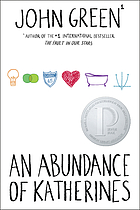
An Abundance of Katherines

Robin, you didn't have to post a reflection AND a booktalk this week, but so glad you did - this is nicely done! AND I want to rush right out and get it.

Green, J. (2006). An abundance of Katherines. New York, NY: Dutton Books.


An abundance of Katherines Colin is a former child prodigy facing life after being dumped for the nineteenth time, by yet another woman named Katherine. His friend, Hassan, suggests a road trip to pull him out of his funk and the two Chicago natives wind up in Gutshot, Tennnessee. They meet Lindsey and her mother Hollis, who offers them summer jobs at the tampon string factory she owns. As Colin attempts to get over Katherine XIX, he struggles to create a mathematical theorem to predict and graphically model the course of his romantic relationships with the Katherines. In the course of getting over himself and his status as dumpee, he must figure out what to do with his life and figure out how to get and keep the girl.
Colin experiences emotional realism due to his heartbreak. He is a believable, likeable character, and his funny, happy-go-lucky friend Hassan contrasts wonderfully with Colin’s anguish. Colin experiences person-against-self conflict because he believes he will never amount to anything. And almost everyone has been dumped, so it’s easy to sympathize with Colin even when he is acting pathetic. What will also resonate with teens is the dilemma of popularity versus doing something that matters. Which is more important? The humor and yes, the profanity, will appeal to teens.
I chose this novel because I’d heard John Green was a very popular Young Adult author who connects with his fans via social media. I loved this novel, and at times laughed so much my 9-year old became curious. Some of the language I could not share with him! Some of the humorous references to Kentucky and Tennessee were a bit irreverent, but that’s my perspective from being from the state.
What really caught my interest was the appendix. John Green had a mathematician friend develop “The Theorem of Underlying Katherine Predictability.”  He explains the basics on how to plot ordered pairs, explains the Cartesian coordinate system, and describes a function. Having students read the appendix would be a fun, creative lead-in to a unit on graphing equations in Algebra. I plan on book talking this book and using the appendix as an introduction to my graphing unit in Algebra 1 this year. 
Mathematics Standard Grade 8 F: Define, Evaluate, Compare functions. Use functions to model relationships between quantities.

Thursday, August 08, 2013

What My Mother Doesn't Know

I love how every semester brings new students and new takes on old reads. Thank you, Brittany Redman, for your take on this book.
Sones, S. (2001). What my mother doesn't know. New York: Simon & Schuster Books for Young Readers.
            What My Mother Doesn’t Know by Sonya Sones is an easy read poetry book that would be very engaging and relatable for teenage girls.  As I read it, it took me back to my own high school experiences.  There were parts that made me giggle because I remember having the same perspective or sharing a similar experience.  The book is written from the perspective of a teenage girl, Sophie, as she journeys through her first year of high school.  Throughout the book, she tells of her experiences at school, her difficulty with her family, her attraction to boys, and her relationship with her two best friends, Rachel and Grace.  In the end, Sophie must decide how much other people’s opinions matter to her.  If I were using the somebody, wanted, but, so technique to summarize this book, I would say: Sophie, a freshman teenage girl, wanted a boyfriend and someone to hang out with, but she never imagined she would connect with Murphy.  Now she must decide how much her friends’ opinions matter to her. 
            What My Mother Doesn’t Know is a fun realistic fiction coming of age novel that is written in free verse form.  It is classified as realistic fiction because the character, Sophie, is a seemingly real teenage girl in a realistic setting, yet her story is fictional.  It is considered free verse because most of the poems are unrhymed poetry with little or light rhythm.  However, each poem in the book is unique.  Here is a short excerpt of one of the free verse poems:
But Dylan calls me Sapphire.
He says it’s because of my eyes.
I love the way his voice sounds
When he says it.
Sapphire.
The book is also written in a chronological format as Sophie tells pieces of her story as her freshman year progresses.  The free verse form is a perfect fit for this book and is good for teens because it is less wordy than a typical novel. While this book will appeal mostly to female students because of the main character, it presents lessons that would be helpful for all teens. 
                There are several activities that could be used along with this book in the classroom.  Before reading, the teacher could present students with a mini-lesson on free verse poetry.  It would also be a good idea to read the first several poems aloud to students.  During reading, students could work on making predictions.  They could predict who they think the masked man is and how Rachel and Grace will react to Sophie’s news.  After reading this book, students could work in pairs to create their own free verse poems.  They could create a poem from their own perspective or from the perspective of another minor character in the book.  Another neat activity would be to have students plan a week long “stay-cation” in their home town like Sophie does in the story.  The standards that could be used include: CCSS.ELA-Literacy.W.9-10.3d Use precise words and phrases, telling details, and sensory language to convey a vivid picture of the experiences, events, setting, and/or characters, CCSS.ELA-Literacy.RL.9-10.2 Determine a theme or central idea of a text and analyze in detail its development over the course of the text, including how it emerges and is shaped and refined by specific details; provide an objective summary of the text.
The big questions I might ask my students after reading this book are: If you had to write a moral for this book, what would it be?  Do you think differently about high school after reading this? How do you decide what is really important to you? 

Tuesday, December 04, 2012

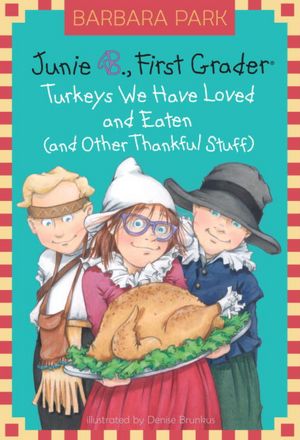
Junie B., First Grader: Turkeys We Have Loved and Eaten

Thanks to Julie Lynn for enthusiasm in early reader chapter books.
Park, B.  (2012).  Junie B., first grader: Turkeys we have loved and eaten (and other thankful stuff).  New York: 
      Random House Children's Books.
Age: 6 and up
Genre:  This short chapter book falls into the realistic fiction category, as the characters are fictional, however the plot tells of events that could actually happen in real life.
Summary:  Junie B. Jones, a rambunctious first grader in Mr. Scary's class is approaching a special holiday: Thanksgiving!  This year, there is a school-wide competition in which all classrooms must work together to create a "thankful list."  The class with the best list will be crowned the winners, earning a home-made pumpkin pie, baked by the school's very own 'lunch lady,' Mrs. Gladys Gutzman!  Although the prize is a bit of a bummer to the youngsters in Mr. Scary's classroom, they work together anyways to create the most unique, seemingly off-the-wall, and honest thankful list that a group has ever written.  Throughout the process, Mr. Scary learns a lot about his class and about the sweet and simple things that first graders hold near and dear to their hearts.
Reflection:  I have to admit that being a first grade teacher, I am a HUGE fan of Junie B. Jones, and I was probably more excited than any of my students when I learned that Barbara Park was back in business and had written her first new addition to the series in years!  I immediately swopped up a copy of the book, and could barely wait until November to crack it open!  I LOVE using these books as read-alouds for my first graders because the characters are very well developed  (as Park is excellent at building characterization in so many ways) ...my students quickly become attached to the characters, by getting to know the appearances, actions, and personalities of each.  Additionally, the plots are well written and because they are chronological, they are easy for my class to follow over the course of a couple of weeks.  Additionally, in each book can be found examples of person-against-self and person-against-person conflict, written in such a way that even very young readers can follow along with the struggles of life. My favorite feature of the Junie B. series is the humor packed into each chapter!  Each book brings a fresh wave of humor, funny enough for adults (!!) and on a level at which young children catch and follow the humor as well.... Honestly, I can't say enough about Barbara Park's abilities as a writer!  I am keeping my fingers crossed that she has plans to continue adding novels to the Junie B. collection!
Big Questions/Activities for Kids: Because of Park's master ability to vividly describe and build up both the plot and her characters, I love to use Junie B. Books (such as this one) with the skill of visualizing.  After reading a chapter, I ask students to sketch out their visualization of a specific event.  It's fun for them to share their drawings, and although each individual may show the even from a different perspective in their artwork, they are always amazed at how many details in their pictures/visualizations are alike!
-Additionally, I asked my students what they would like to add to Mr. Scary's 'thankful list.'  Turns out, they had been inspired by the honesty and uniqueness of the responses given by the characters in the book, so they were able to create some very unique responses of their own! 

Tuesday, June 19, 2012

Pictures of Hollis Woods

Thanks, Morgan Hagedorn, for this reflection.

Giff, P. (2002). Pictures of Hollis Woods. New York: Scholastic Inc.
Let me begin by saying that this book is an excellent realistic fiction book that focuses on   family. If you haven't read this book, it's an excellent one to read. When I Googled this book to get a picture for my blog, I discovered that this book was made into a Hallmark Hall of Fame Presentation featuring the well-known actress Sissy Spacek and was nominated for Golden Globe. The book is also a Newbery Honor Book. The recommended ages for this book are ages 10-12. I found this book appealing because of the vague title. I assumed that Hollis woods was a person, but I wanted to know for sure. I also wanted to know what types of pictures the title was referring to.

The main characters in this book are Hollis, Steven, Josie, Mr. and Mrs. Regan, and Beatrice. The main setting of the story is in the city of Branches, which is where the Regan family lives. Hollis Woods is a young foster child who has the tendency to run away from every home she lives in, even when she's happy. Hollis ends up meeting a family that she loves so much, but because of a certain circumstance, she ends up leaving them. During this time that she's away from this family, she lives with a dependent woman named Josie. Hollis and Josie become wonderful friends, but Hollis's heart truly belongs with Steven, Izzy, and John Regan. Hollis's main passion and hobby is her ability to draw beautiful pictures. Hollis escapes from her reality by drawing pictures. She is passionate about landscapes and the outdoors; therefore, her pictures depict a lot of outdoor landscapes.

The entire time I read this book, I kept wondering what was going to happen to her, and whether or not she would return to the Regan family. The book tells many of Hollis's experiences with Josie and her experiences with the Regan's. Giff uses tons of flashbacks in this story, which I feel adds to her experiences and passion toward the people that she loves. Giff uses italics to show us when Hollis is experiencing a flashback. In one chapter, you are reading about her experiences with Josie, and the next chapter, you are reading about Hollis at the Regan's home. The whole story is full of flashbacks.

Conflict is a very important idea in this book. The type of conflict seen is person-against-self. Hollis experiences many personal struggles in this book, and as the book progresses, you see her change for the better. She constantly fights with herself to figure out where she is going to go next, whether or not she wants to stay where she is, etc. The story is told in first person point of view where you see the constant use of the word "I." Hollis is a also the protagonist. While reading the story, you learn so much about her character. You learn of Hollis's weaknesses, her struggles, and her strengths.

The theme is also very important in this story. A possible theme for this story could be, "Family does not have to only include those who are blood related. Family is more than than. Relationships that are made and experiences that people face often bring them close together as a family." I cannot imagine what Hollis went through all the years that she did not have a family. My family is so important to me, and without them, I would feel lost. That's why you feel extremely happy for Hollis when she meets people that take her in as their own.. Hollis's encounters with the Regan family bring such great emotions and make you feel such joy for her.

BIG questions - Why does Hollis take such a long time to return to the Regan family? Being a foster child would be such a challenging and emotional thing. Would you "run" the way that Hollis does? The book never said why Josie was so dependent on people. Why do you think Josie needed Hollis the way that Beatrice said she did?

Rules

Reflection from Cara Esarey - a book I haven't been able to read yet - but I will!

Lord, C. (2006). Rules. New York: Scholastic Press.


            Rules fits in the genre of realistic fiction because all of the events and characters are within the realm of possibility.  These actual events have not occurred in real life, but they could.  Because this story is realistic fiction, many students will find it relatable.  I think this book could fit into the situational realism and contemporary realism categories of realistic fiction.  I think it fits into the situational realism category because this is a family story that is likely to happen to many students.  It is about a traditional nuclear family of a mom, dad, brother and sister.  The brother has autism and it goes through their lives told by Catherine, the narrator, a twelve year old girl.  The story is told in the first person.  Students will relate to this book because they will be about the same age as the narrator and since autism is becoming more prevalent, many probably have someone in their family or know someone with autism.  I think it fits into the category of contemporary realism because it deals with issues of the present day culture.  Autism is becoming more prevalent and chances are students have met someone with autism. 
The issue of people with disabilities can be a controversial topic.  Rules shows how Catherine deals with this in her daily life.  She loves her brother David, who is eight years old.  It shows how she struggles taking care of him and how sometimes she wants him to just be “normal”.  This story takes place over summer break.  Catherine goes with her mom and David to occupational therapy.  There she meets a boy named Jason, who also has disabilities.  It is never said what specific disability Jason has, just that he is in a wheelchair and has to use a communication book in order to communicate with others.  Catherine and Jason spark up a friendship and she uses her artistic skills to make him new words and pictures for his communication book. 
This book also deals with acceptance by peers because Catherine does not automatically tell her new neighbor Kristi that Jason has a disability when Kristi suggests that Catherine ask Jason to the dance.  She lies and says that she is not interested in going to the dance and that she is busy.  You’ll have to read the book to find out how Catherine solves this dilemma!  She was also embarrassed when Kristi first moved in because she feared that Kristi would not understand about David. 
As a special education teacher, I very much related to this book.  I think this would be a great book for all children to read.  It can teach them to be kind and understanding individuals.  Catherine is a great example of a kind and caring young woman.  This book also shows them that it is okay to be different and that not everyone has to be the same.  I think this book has a lot to teach young people and it will keep them interested.  I think they will find it easy and fun to read because it is written from the perspective of someone their age.  This book is also a Newberry Honor Book and Schneider Family Book Award winner.
Big Questions:  How would you handle the situation with Kristi, Jason, and the dance? 
Can you see yourself spending your summer the way Catherine did taking care of David and getting to know Jason? 
What can you do to help raise awareness and acceptance of those with disabilities? 

Shredderman: Secret Identity

Thanks Laura Beth Menser, for a reflection on a book I want to read.
Van Draanen, W.  (2004).  Shredderman:  Secret identity.  New York:  Alfred A. Knopf.
         Shredderman:  Secret Identity, by Wendelin Van Draanen, is a children’s realistic fiction chapter book about a fifth-grade boy, Nolan, who creates a secret identity to stop the mean school bully, Bubba.  In the beginning of this progressive plot, we learn about the background.  Bubba, the antagonist of the story, is described as having “rocky knuckles” (pg. 1) and “killer breath” (pg. 1).  He is also known to lie, cheat, steal, and give his peers mean names (pg. 4-5).  Nolan is the protagonist and is described as having a sloppy appearance.  His hair “has a life of its own” (pg. 27) and his dad reminds him that his socks go inside his pants (pg. 27).  There are two different types of conflict that occur throughout the plot.  The person-against-person conflict develops at school where Bubba, his friends, and Freddy all pick on Nolan.  They call him “Nerd”, which is the name Bubba created for him.  Nolan struggles with the person-again-person conflict because he is not confident in himself enough to stand up against Bubba.  When Nolan’s “Happy Hippie” teacher, Mr. Green, writes the words “Nolan—You shred, man!  Awesome!” (pg. 39) on his paper, Nolan gets an idea to create a secret identity (pg. 45), named Shredderman, in order to stop Bubba from bullying him and his peers.  As the conflict develops, Nolan creates a website called Shredderman, where he “shreds” information about Bubba.  This information includes pictures and videos of Bubba doing mean things to others, such as knocking over his peers’ lunch trays and calling people names.  Will Bubba find out that Nolan is the Shredderman?  Will the Shredderman make a positive impact on Bubba?  Will the students finally take a stand against Bubba?  You’ll have to read this book to find out the answers to these questions!
         Wendelin Van Draanen used different types of literary devices throughout the story.  One of the literary devices she used was a simile, which compares two unlike things.  An example of this is when Nolan compared the information about Shredderman website’s spreading like a cyber-virus.  “It spread like a cyber-virus around the playground.” (pg. 96).  Another literary device she used was a metaphor, which suggests similarity between two objects or ideas.  “I was still standing, but my knees had turned to jelly.” (pg. 124).  A third literary device she used was an onomatopoeia, which imitates the sound that it is representing.  “Whoosh!  Whoosh!  Whoosh!” (pg. 91).
I found this book listed under the recommended realistic fiction books section in our textbook, Essentials of Children’s Literature.  I had never heard of this book before.  The title sounded interesting, so I wrote it down and looked it up at my local public library.  When I read the synopsis on the inside of the dust jacket, I knew it sounded like a book I would like.  In fact, this book is the first in the Shredderman series.  There are three more books in the series, which I look forward to reading.  I would absolutely recommend this book, as well as the rest of the series, to other teachers and for students (2nd-4th grade). 
         This book lends itself to an open discussion on bullying at school.  Unfortunately, bullying is a growing problem in our schools today.  Students are not only getting called names or getting beat up, but they are also being cyber-bullied.   Some BIG questions you could ask your students are, “If you could create a superhero based on your talents and abilities, what would it be and how would you use them?  How would you respond if someone bullied you or your friend(s) at school? 
        
On Shredderman’s website, there is a wealth of information and resources to use in the classroom.  There is a biography of the author and illustrator, a meet the characters section, fun for superheroes, and several resources and activities (crossword puzzles, word jumbles, quizzes, and math story problems).  Click on the link below to go to Shredderman’s website.