Thanks to LauraLee Samples.
Paulsen, G. (1993). Nightjohn. New York, NY: Delacorte Press.

Paulsen, G. (1993). Nightjohn. New York, NY: Delacorte Press.
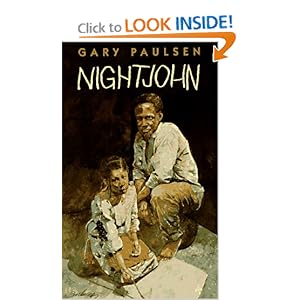
I chose
this crippling display of the hardships faced in the American South in
the 1850's. Author Gary Paulsen introduces us to a young slave girl
named Sarny and a man that changed her life forever, Nightjohn. Through
vivid details of slave life on the Weller plantation, Sarny explains to
us from her own first person point-of-view, this story of survival and adventure.
This "young protagonist must rely on will and ingenuity to survive a
life-threatening situation" (Brown, Tomlinson, Short, page 157). This
is a tale of whip-lashing, toe-chomping, dog-attacking avoidance. To
survive slave life, everyone must follow and obey the master's orders.
In this case, "the master" is an old whiskey-bent white man who
contributed in making lives miserable.
Sarny brought me to tears with her take on breeders, or "birthing
mammies," and how these women were impregnated, delivered babies to a
wet nurse, and sent back out to work in the fields. According to Sarny,
"Breeders don't get to keep their own babies because they be spending
all their time raising babies and not working" (Paulsen, page 16). The social realism displayed
throughout this book truly forced me to gain a deeper understanding of
society and the conditions so many people were forced to endure.
I have always been drawn to diaries, journals, and texts from the days
of slavery. Although it pains me to see the injustice and disgraceful
acts that took place in our own free country, I believe I have a
greater appreciation for where we have come. Secondary students (grades
6-12), should be required to read this story as it provides insights
into much more than slave-whipping background of our country.
Understanding how a young slave girl learned to read and write, before
grasping the consequences of her desires, I felt her sense of
excitement. The words on the page, "I make the word... The first word"
(Paulsen, page 60) really tugged at my heart. Although not much
excitement was shown in the text itself, I felt Sarny's excitement in
making her first word!
 |
| (Paulsen, page 60) |
As I read, the teacher in me made note of the variety of
multidisciplinary ways this story could be incorporated into middle and
high school curriculum. After reading the book yourself, check out the
multitude of shared extensions:
Reading:
1. Students can write journal entries about how it would feel to be Sarny, Nightjohn, or a slave in these conditions.
2. Create a story about a time when you sacrificed for someone else,
including thoughts and feelings and connecting to details from the
story.
Math:
1. In the book, Mammy kept the children's ages by marking sticks. How
else could she have kept track? How does this connect to strategies we
use for keeping track now?
Science:
1. Conduct research regarding crops grown on plantations at this time. Discover the conditions needed for these crops to grow.
2. Plant the crops grown at this time and keep observations of the growth.
Social Studies:
1. Locate and research slave states in the South versus free states in
the North. Divide into groups to gather information and present the
findings to the rest of the class.
2. Within the study of slavery, connect this book with others in order
to compare and contrast life in the American South in the 1850's.
Just a few other books related to slavery:
1. Sarny, by Gary Paulsen
2. Brady, by Jean Fritz
3. Autobiography of a Female Slave, by Mattie Griffith
4. Breaking Free, by Louanna Gaeddert
5. Bright Freedom's Song: A Story of the Underground Railroad, by Gloria Houston
6. Day of Tears, by Julius Lester
7. Chains, by Laurie Halse Anderson
BIG questions for use with this story:
How would you teach someone to read and write, if given the chance?
What does it mean to make sacrifices for others?
Why is reading and writing important? Is it the same in all cultures?
Be sure to check out the 1996 movie of Nightjohn!
Additional Citations:
Lynch-Brown, C., Tomlinson, C.M., Short, K.G. (2011). Essentials of children's literature. Boston, MA: Pearson.


No comments:
Post a Comment